Showing posts with label coachella. Show all posts

Thursday, July 20, 2017

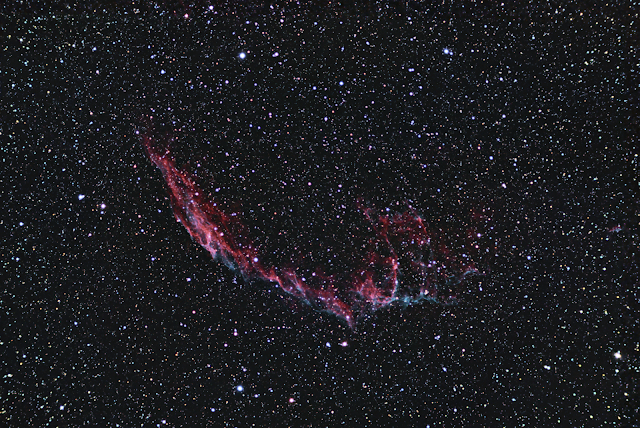
The Eastern Veil Nebula NGC 6992

The Veil nebula has been my deep sky subject for the past month, and I'm finally done with the eastern portion. The desert heat and humidity we've had recently did not help at all, but us desert rats find ways to overcome this every summer. 

Next up is the western portion of the Veil nebula, which contains NGC 6960 the Witches Broom Nebula. I'm hoping to get the western side done before the end of the month.

NGC6992 Eastern Veil Nebula
taken in Cathedral City, CA
5h40m total exposure time
61 lights 4,5, and 6 minute exposures
48 darks
64 flats
80 bias
Stacked in DSS

The Eastern Veil Nebula NGC 6992

Tuesday, April 4, 2017

Comet 41P/Tuttle-Giacobini-Kresak 4-1-17

This was my first attempt at imaging a comet, and after tons of research online I was actually able to pull off some interesting images, and even a video of its movement. Comet 41P/Tuttle-Giacobini-Kresak was not showing any signs of a tail, at least for now. The comets closest approach to the Sun is on April 12 2017, and it might start showing signs of a tail around then. Unfortunately, this comet is not really a naked eye object, and was even hard to spot in binoculars under our light polluted valley. This is why it's important to always turn off unnecessary lights at night, and if at all possible use lighting that does not pollute our night skies.

There are various ways to post process a set of comet images, one way stacks the comet and leaves the stars to trail. The other way is to stack the stars and the comet, which leaves you with a nice comet and a fairly clean star field in the background.

This was taken on 4-1-17 in Cathedral City, CA
Orion ST80
Canon 450d
Celestron AVX Mount
ASI120MC-s Guide Camera
Astromania 60mm Guidescope

Comet 41P/Tuttle-Giacobini-Kresak
 Comet with trailing stars

Comet 41P/Tuttle-Giacobini-Kresak
 Comet and corrected star field
Comet 41P/Tuttle-Giacobini-Kresak
Inverted view


Inverted timelapse video, about 2 hours
Saturday, March 11, 2017

Moon Craters taken 3-8-17

I snapped an image of Clavius (crater) and Longomontanus (crater) the other night. The seeing was amazing, and the images show all kinds of detail.

Celestron Nexstar 6se
Celestron AVX Mount
ASI120MC-S Camera
Taken in Cathedral City, CA

 Clavius (crater)


Longomontanus (crater)

Thursday, February 2, 2017

Jupiter 2-1-17

Finally, Jupiter is back in the night sky! Oh, how I have missed this beautiful gas giant of a planet. As much as I enjoy imaging deep sky objects, my first love will always be planetary imaging. There is just something about imaging our local neighbors that puts me in a wonderful mood. Watching Jupiter rotate throughout the night is a sight to behold, and for such a large planet it does so about every 10 hours as opposed to our 24 hour Earth rotation. This means I can watch the great red spot on Jupiter slide across the surface in a matter of hours, and I can even see the movement of its 4 brighter moons. The black dot you see in the image is a shadow transit of Europa, one of Jupiter's larger moons.

P.S. This is my best image of Jupiter...so far

Technical details:
9,000 frames de-rotated in Winjupos
Stacked in Autostakkert2
Sharpened in Avistack2 and PS
Celestron Nexstar 6se telescope + 2x Barlow + 24mm eyepiece and extension tube
Celestron AVX Mount
Asi120mc-s camera

Jupiter 2-1-17

Tuesday, November 15, 2016

November 14 2016 Supermoon taken in Cathedral City, CA

I hope you all enjoyed the Supermoon, here's a hi-res image I took of the Supermoon in Cathedral City! This is a 25 panel mosaic stitched together to create the final image. I will say that I didn't notice much of a difference in the overall apparent size of the full Moon, but it was a heck of a lot brighter than normal.


Wednesday, October 19, 2016

Spot the Space Station over the Coachella Valley tonight


Spot the International Space Station over the Coachella Valley twice tonight! The first one is almost 7 minutes long and starts at 6:39pm. At 7 minutes long, this will appear to be a slow moving, but increasingly brightening star crossing the sky. It will appear in the Northwest at a 10 degree elevation and pass through the Little Dipper near the north star Polaris. Maximum elevation is 51 degrees, then it will start to fade away into the Southeastern sky. At a magnitude -3.6 it should be pretty bright, the Sun sets at 6:06pm so it will not be the darkest sky but I've personally seen the station pass by in daylight before, so no worries. 

The second chance tonight to spot the Space Station will be at 8:18pm, this one only last for 1 minute and will be low on the horizon at a max elevation of 11 degrees and reach a magnitude 1.0. If you have a unobstructed view of the Southwest, it will pass very near the planet Saturn. 


Saturday, October 1, 2016

Triangulum Galaxy M33 Backyard Astrophotography

The Triangulum Galaxy, or Messier 33, is a spiral galaxy in the constellation Triangulum, and is visible to the naked eye under dark sky conditions. Unfortunately, deep sky objects like this are not visible to the unaided eye here in the Coachella Valley due to city light pollution. I was able to capture this on 9-30-16 during the new moon phase, and am very happy with how it turned out.

3 hours total exposure time

37x150s lights
12x180s lights
13x240s lights
68 darks
40 bias
38 flats

Equipment:
Celestron Nexstar 6se + wedge
6.3 focal reducer
canon 450d
asi120mc-s guiding

Triangulum Galaxy M33 Backyard Astrophotography


UPDATE!

Reprocessed this data with an additional 4 hours of exposure time for a grand total of 7 hours

Triangulum Galaxy M33 Backyard Astrophotography


Saturday, August 6, 2016

Moon and Jupiter Conjunction over San Jacinto Peak 8-5-16

A conjunction of the Moon and Jupiter over the beautiful San Jacinto Mountains in Palm Springs California, the last one of the year I believe. Jupiter is inching closer to the horizon as each day passes, and will soon disappear from view as it does its dance with the Sun. As the planetary season winds down, I will say I am going to miss Jupiter most of all. It put on one hell of a display during this years opposition, and easily dominated the night sky for months. As sad as I am seeing it go, I am also excited because the winter sky is starting to make an appearance in the pre-dawn hours. The great Orion Constellation (and nebula), the Pleiades, the Taurus Constellation with the mesmerizing star Aldebaran and The Hyades open cluster are all starting to make their way into the night sky. We all know what that means out here in the Coachella Valley...the best winter weather in the world! And the snowbirds...lots and lots of snowbirds lol

Technical Details:
Canon 450d
ISO 100
f/5.6 MF
1/3sec exp
Post processing done in CS6


Moon and Jupiter Conjunction over San Jacinto Peak

Friday, July 22, 2016

M11 Wild Duck Cluster 7-21-16 Coachella Valley, CA

The Wild Duck Cluster, or  M11, is an open cluster in the constellation Scutum. This cluster is a rich and compact open cluster, known to contain about 2900 stars. Its name is derived from the brighter stars forming a triangle which apparently resemble a flying flock of ducks (I don't see it, but that's just me).

This is a stack of 30x1 minute exposures + 12x2 minute exposures at ISO 1600, camera used is a Canon 450d, and a Celestron Nexstar 6se telescope + wedge and a 6.3 focal reducer, 60mm guidescope + asi120mc-s. Taken in Cathedral City, CA 7-12-16

Wednesday, July 20, 2016

Moon Mosaic: Coachella Valley Astrophotography 7-17-16

This is not your typical Moon picture, but a mosaic of 11 pictures of the Moon stitched together to create a very large and detailed image. 

This was actually created using 11 short video clips: I pointed at one part of the Moon, took a short video at 64 frames per second, and then used stacking software which picked the best of those frames and added them together to produce a single image. I then moved the telescope to a different part of the Moon and repeated the procedure 11 times, until I had images of the entire surface of the Moon. These were then processed to sharpen the details, and finally stitched together to create the mosaic. 

Taken 7-17-16 in Cathedral City, CA
Nexstar 6se + 6.3 focal reducer
asi120mc-s camera
64fps 3000 frames per video
11 videos total
Dimensions 3300x3100


Friday, July 15, 2016

Eagle Nebula M16 Coachella Valley Astrophotography

The Eagle Nebula, also known as Messier 16 or M16, is a young open cluster of stars in the constellation Serpens. It’s the location of several famous structures including the Pillars of Creation.

One of the inspirations that led me down the road to astrophotography was the beautiful image the Hubble telescope sent back in 1995 of the Pillars of Creation inside the Eagle Nebula. It is truly a breathtaking image, one for the ages. I was blown away, as were many others I am sure.

This is a stack of 20x2 minute & 25x3 minute exposures at ISO 1600, camera used is a Canon 450d, and a Celestron Nexstar 6se telescope + wedge and a 6.3 focal reducer, 60mm guidescope + asi120mc-s. Taken in Cathedral City, CA 6-4-16


Thursday, June 2, 2016

Lagoon Nebula M8 taken in Cathedral City, CA

The Lagoon Nebula, or M8, is an emission nebula in the constellation Sagittarius. This nebula is a giant interstellar cloud some 4,000-6,000 light-years from us here on Earth. Currently, the best time to view the Lagoon Nebula in the Coachella Valley is around 2am looking south. It lies near the Milky Way core, and has plenty of beautiful neighboring eye candy such as the Trifid and Eagle Nebula. As with most nebula, this one is best viewed with a high powered telescope and nebula filter.

Equipment used: Celestron Nexstar 6se with wedge + 6.3 focal reducer, Canon 450d

22x180s lights
22 darks
22 bias
22 flats

Processed in DSS


Friday, May 20, 2016

M27 The Dumbbell Nebula 5-18-16

The Dumbbell Nebula, or Messier 27 is a planetary nebula in the constellation Vulpecula. In 1764, Charles Messier discovered the Dumbbell Nebula, and was the first of its kind to be discovered, a planetary nebula. A planetary nebula is named more for its round appearance to early astronomers, and has nothing to do with actual planets. A planetary nebula is actually the remains of an old exploded star, and is made up of  ejected ionized gas.

This is a stacked image of 17 1 minute exposures at ISO 1600, 17 light frames, 17 dark frames, and 17 bias frames. Stacked in DeepSkyStacker with minor tweaks to contrast and brightness in CS6. These were all taken in my backyard in Cathedral City, CA with average seeing and visibility.

On a side note, I am personally blown away by this image. There has to be over a million stars in the picture! How cool is that right?

*UPDATE
After going through the data, and some help from internet astronomy friends, I Have re-edited using PixInsight LE and was able to pull out much more data this time around. The first 2 images are the new edits, and the last 2 images are the old data.


M27 The Dumbbell Nebula 5-18-16


Sunday, May 15, 2016

Mercury Transit of the Sun from the Coachella Valley 5-9-16

The Mercury transit of the Sun on May 9, 2016 did not disappoint in the Coachella Valley, California. The sky was clear, and the weather was wonderful. This was an amazing event to witness, and was my first Mercury transit ever seen. The last Mercury transit occurred in 2006 and the next one won't come until 2019. The first image is a composite showing the path of Mercury crossing the surface of the Sun. The next  picture is single frame exposure, and the last image is another single frame exposure with a bit of a zoom on Mercury. Enjoy, and happy stargazing!


Mercury Transit of the Sun from the Coachella Valley 5-9-16

Mercury Transit of the Sun from the Coachella Valley 5-9-16

Mercury Transit of the Sun from the Coachella Valley 5-9-16

Monday, May 2, 2016

Saturn over the Coachella Valley, CA 5-2-16

I got the telescope out early this morning to photograph an ISS Moon transit, but unfortunately it occurred at 6:42am and the Sun was too bright, so I was unable to catch it. I did however catch a beautiful shot of Saturn. Saturn is currently at an apparent magnitude of .17 and will peak in brightness at the beginning of June this year. This is by far my best image of Saturn to date, the surface colors look amazing, as does the famous rings. This was taken with a Celestron Nexstar 6se + Phillips spc900 webcam 24mm eyepiece 2x barlow 2000 frames stacked in Avistack.

Saturn over the Coachella Valley, CA 5-2-16

Saturday, April 30, 2016

First attempt at imaging another galaxy, M51

Tonight was my first attempt at imaging another galaxy. This is M51 the Whirlpool Galaxy. This was taken with a canon 450d and a nexstar 6se. 19 lights 19 darks 19 bias. This will only get better, as i have a wedge on the way for my 6se. Exposure times should improve, but overall I am pleasantly surprised with what I got, as this is not an easy target in light polluted skies.


Milky Way, Mars, Saturn, and Antares triangle

4-30-16 High winds, poor seeing, and a last quarter Moon got in my way this morning but I did manage to catch the Mars, Saturn, and Antares triangle along with a little Milky Way so it wasn't all for nothing. This was a 2 minute exposure ISO 1600 Canon 450d piggybacked on a Celestron Nexstar 6se.

Milky Way, Mars, Saturn, and Antares triangle

Monday, April 18, 2016

4-17-16 Mars is quickly approaching opposition

Mars is quickly approaching opposition, and is looking better each day. The Mars opposition occurs May 22 and will not disappoint at an apparent magnitude -2.06 , so get your cameras ready.


Moon and Jupiter Conjunction 4-17-16

Tonight had a fantastic conjunction of our Moon and the planet Jupiter, meaning they were very close to each other in the night sky. This image is a composite of two separate images with different exposures that I combined together to create the final image. Taken with a Canon 450d at f/5.6 1/400s and 4s at ISO 100

Moon and Jupiter Conjunction 4-17-16

The Moon 4-17-16, a Waxing Gibbous Moon 87% full

I snapped this single exposure image of the Moon tonight with my Canon 450d attached to a Celestron Nexstar 6se with a 6.3 focal reducer. Tonight's Moon is a Waxing Gibbous, and is about 87% full. This months full Moon lands on April 22nd at 1:24 am, and is called the Pink Moon in the farmers almanac due to spring flowers.

The Moon tonight 4-17-16, a Waxing Gibbous Moon 87% full