Showing posts with label Celestial event. Show all posts

Sunday, May 15, 2016

Mercury Transit of the Sun from the Coachella Valley 5-9-16

The Mercury transit of the Sun on May 9, 2016 did not disappoint in the Coachella Valley, California. The sky was clear, and the weather was wonderful. This was an amazing event to witness, and was my first Mercury transit ever seen. The last Mercury transit occurred in 2006 and the next one won't come until 2019. The first image is a composite showing the path of Mercury crossing the surface of the Sun. The next  picture is single frame exposure, and the last image is another single frame exposure with a bit of a zoom on Mercury. Enjoy, and happy stargazing!


Mercury Transit of the Sun from the Coachella Valley 5-9-16

Mercury Transit of the Sun from the Coachella Valley 5-9-16

Mercury Transit of the Sun from the Coachella Valley 5-9-16

Thursday, February 11, 2016

Coachella Valley Crescent Moon 2-10-16

Snapped a picture of the crescent Moon last night and thought I would share it with my followers. It was a great night for stargazing here in the Coachella Valley, and the Moon did not disappoint. The crescent Moon is always my favorite phase of the Moon. I tend to picture in my head a Cheshire Cat smiling down on me from above, but unfortunately I have yet to see it manifest into an actual cat. Maybe someday right?

Coachella Valley Crescent Moon 2-10-16

Coachella Valley Crescent Moon 2-10-16

Friday, January 22, 2016

Jupiter and the Great Red Spot 1-21-16

Jupiter is putting on an amazing show during the winter months here in the Coachella Valley. The gas giant is currently at an apparent magnitude of -2.30, and gaining in brightness each day until peaking on March 6th with an apparent magnitude of -2.49 for the year. These sets of images show the great red spot and storm bands of Jupiter as it rotates across the night sky. My goal for the evening was to really capture the movements of Jupiter's surface in the span of a night. I think it went quite well, for an amateur astronomer.

The Moon is currently in a waxing gibbous phase, which means its almost a full Moon. The Moon played a small negative factor in last nights observing, but overall didn't affect the images too badly. After this months full Moon, which occurs on January 23rd, I recommend a wonderful opportunity to pull out your telescopes and cameras and view the largest planet in our solar system, as well as 4 other bright planets (Mars, Saturn, Venus, and Mercury) all in our night sky at the same time!

Stay tuned for a future post on exactly when and how to spot Mercury here in the Coachella Valley in the coming weeks. It is currently very low on the horizon at dawn and hard to catch with the mountains and palm trees in the way.

I have pieced together a GIF of this evenings Jupiter pictures showing the planetary rotation and movement of the great red spot. This was a really fun project to put together and I could not be happier with the end results.

Jupiter and the Great Red Spot 1-21-16


Next, we have the images that make up the GIF above. These are all stacked images with Avistack, 1800 frames to produce the final images. Taken with a Celestron Nexstar 6SE and a Phillips SPC900NC webcam. 

Jupiter and the Great Red Spot 1-21-16

Jupiter and the Great Red Spot 1-21-16

Jupiter and the Great Red Spot 1-21-16

Jupiter and the Great Red Spot 1-21-16

Jupiter and the Great Red Spot 1-21-16

Jupiter and the Great Red Spot 1-21-16

Jupiter and the Great Red Spot 1-21-16

Jupiter and the Great Red Spot 1-21-16

Jupiter and the Great Red Spot 1-21-16

Jupiter and the Great Red Spot 1-21-16

Jupiter and the Great Red Spot 1-21-16


Here are my final images of Jupiter for the night. I wanted to catch the moons Io and Ganymede, as well as a close up of the great red spot and a bit more of a magnification on Jupiter in general, enjoy!

Jupiter and the Great Red Spot 1-21-16

Jupiter and the Great Red Spot 1-21-16
The Great Red Spot

Jupiter and the Great Red Spot 1-21-16
Jupiter and Io

Jupiter and the Great Red Spot 1-21-16
Jupiter and Io

Jupiter and the Great Red Spot 1-21-16
Jupiter, Io and Ganymede


That is not all we have for today! My next few posts will be about imaging Mars, Venus, and Saturn! I hope you enjoyed my post and I look forward to your comments and feedback via social media and the likes. Clear skies!

Tuesday, January 12, 2016

Jupiter Ganymede Shadow Transit and Great Red Spot 1-11-16

The seeing here in the Coachella Valley was excellent last night, so I had the opportunity to spend the night outside with clear skies, and my trusty telescope. It was quite cold outside, for the valley anyways, so hot cocoa was flowing like water. These are definitely my personal best images of Jupiter, so far! I was actually speechless while processing the videos, but that was more than likely the cold temps outside. I am quite satisfied with the results and I hope you enjoy viewing them. Clear Skies!

Image details - Each image is a 1600 frame video stacked in avistack with minor wavelets adjustments at the end. The first image is actually a composite of two, one for Jupiter and another with high gain to show the moons Ganymede, Europa and Callisto.


Jupiter Ganymede Shadow Transit and the Great Red Spot
Ganymede, Ganymede Shadow Transit, Great Red Spot, Europa, and Callisto
Nexstar 6SE + Phillips spc900nc + tube extender

Jupiter Ganymede Shadow Transit and the Great Red Spot
Ganymede Shadow Transit, Great Red Spot
Nexstar 6SE + Phillips spc900nc + tube extender

Jupiter Ganymede Shadow Transit and the Great Red Spot
Ganymede Shadow Transit, Great Red Spot
Nexstar 6SE + Phillips spc900nc + tube extender

Jupiter Ganymede Shadow Transit and the Great Red Spot
Ganymede Shadow Transit, Great Red Spot
Nexstar 6SE + Phillips spc900nc + 2x barlow

Jupiter Ganymede Shadow Transit and the Great Red Spot
Ganymede Shadow Transit, Great Red Spot
Nexstar 6SE + Phillips spc900nc + tube extender

Jupiter Ganymede Shadow Transit and the Great Red Spot
Io, Ganymede Shadow Transit
Nexstar 6SE + Phillips spc900nc + tube extender

This last image actually shows Io popping out from behind Jupiter


Sunday, January 3, 2016

January List of Events in the Coachella Valley

moon and San San Jacinto Mountains
The first month of 2016 will be an exciting start to a new year for astronomy enthusiasts. There is going to be plenty of celestial events, and interesting observations so keep your eyes on the night sky.

Unfortunately, El Nino is coming our way, and that means clouds and rain. Now this may sound great for obvious reasons, such as the drought, but it does not bode well for astronomy and astrophotography. Clouds make it generally very poor for stargazing.

First we have the annual Quadrantids Meteor Shower on January 3-4. You can catch the meteors starting after sundown on Sunday night, and watch them throughout the evening and into Monday morning. The best time for viewing is the actual peak, which starts at 3am and ends at the first light of the day. This particular meteor shower is above average, and NASA is estimating around 80 meteors per hour in areas with dark skies and little to no light pollution.

January 2-6 Spot the space station! Early morning hours seem to be the sweet spot for viewing the ISS in the Coachella Valley. Head on over to Spot the Station via NASA here to see dates/times and other information related to local sightings.

January 9th @ 7:00pm Star Party hosted by the Sun City Palm Desert Astronomy Club, located at the east greenbelt off Donny Circle, just south of Alliance Way in Palm Desert. More info here.

January 10th we have the New Moon, which is a great time to view the galaxies, nebulae, star clusters, and other types of deep sky objects. Without the interference of the Moons glow, faint objects in the sky can be more clearly seen.

January 16th 5pm-8pm Star Party hosted by the ASTRONOMICAL SOCIETY OF THE DESERT, located at the visitors center. Directions and information can be found here.

January 24th is this months Full Moon,

January 27th @ 7:00pm is the monthly general meeting of the Sun City Palm Desert Astronomy Club. Located in the Tahoe Room at the Lakeview Clubhouse. This month, they will be talking about "Hubble and the Sagittarius Star Cloud". More info here.


Thursday, December 10, 2015

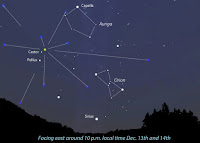
Viewing Guide to the 2015 Geminid Meteor Shower in the Coachella Valley

 Geminid meteor shower
Unfortunately, it looks like clouds and rain in the Coachella Valley for this years Geminid Meteor Shower. The meteor shower peaks on the night of the 13th into the pre-dawn hours of the 14th. The usual best viewing times for meteor showers is any time after midnight. As of today, the weather man is showing late night clouds and a chance of rain. We certainly need the rain out here, but I was really hoping for clear skies.

This years meteor shower is going to be a good one, with a maximum of 120 meteors per hour, weather and light pollution permitting of course. The night of the 13th and the night of the 14th will both offer great views of the meteors. If you would like more information on this years Geminid Meteor Showers you can read what NASA had to say here and here, and a great read here by Universe Today.


Monday, December 7, 2015

Total Lunar Eclipse - 9/28/15

I figured since I used one of my lunar eclipse pictures as my header image, I might as well post a few more from that night. These pictures were taken during this years spectacular total lunar eclipse that occurred on September 28th. My wife and I set up the telescope in the front yard and waited for the Moon to rise. I was actually surprised and extremely excited to see a few neighbors also outside staring up in anticipation. By the time the Moon had risen above the palm trees and neighbors houses the eclipse was already underway, but I knew this was going to be the case beforehand with southern California in general. The equipment used was a Celestron Nexstar 6SE and a HTC EVO + Cell Phone Adapter Mount.

Total Lunar Eclipse -  9/28/15

Introductions...

Introductions are in order, this being my first official post and all. Hello, and welcome to the Coachella Valley Astronomy and Astrophotography blog. My name is Michael Roemelen and I live in the Coachella Valley. I have been an avid amateur stargazer for years now and just recently got into taking pictures of the beautiful night skies here in the Coachella Valley and surrounding areas. I am going to take a guess here, and say that you have landed on my blog because you have an interest in Astronomy and/or Astrophotography in or around the Coachella Valley. Fantastic! Me too!

My purpose for creating this blog is to share with the world my personal pictures of the night skies. I have posted many important links that I personally use and I plan on updating the site with new and exciting pictures whenever I can. So, please feel free to stop by and utilize the links and widgets available on the site. There are links to ISS sightings, moon phases, stargazing tours, clear sky data, celestial events, and others pertaining to the Coachella Valley and Southern California.