Showing posts with label Southern California. Show all posts

Saturday, October 21, 2017

Pacman Nebula NGC 281

Pacman Nebula NGC281
Taken in Cathedral City, CA

90/500 Refractor
2" Astro-Tech Field Flattener
Canon 450d modded
Baader 495nm Longpass filter
Astronomik CLS CCD Clip Filter
Celestron AVX Mount

10 Hours total exposure time
66 Lights varying 7-19 minute exposures at iso 200-400
60 Darks
40 Flats
80 Bias
Stacked in DSS, edited in CS6

Pacman Nebula NGC 281

Tuesday, September 26, 2017

Triangulum Galaxy M33

Triangulum Galaxy M33
Taken over 2 nights at Lake Cuyamaca, CA

90/500 Refractor
2" Astro-Tech Field Flattener
Canon 450d modded
Baader 495nm Longpass filter
Astronomik CLS CCD Clip Filter
Celestron AVX Mount

5 Hours total Exposure Time
20x900s ISO 800 Lights
11 Darks
43 Flats
30 Bias

Stacked in DSS, edited in CS6

The Triangulum Galaxy is a spiral galaxy approximately 3 million light-years from Earth in the constellation Triangulum. It is cataloged as Messier 33 or NGC 598, and is sometimes informally referred to as the Pinwheel Galaxy, a nickname it shares with Messier 101. The Triangulum Galaxy is the third-largest member of the Local Group of galaxies, behind the Milky Way and the Andromeda Galaxy. It is one of the most distant permanent objects that can be viewed with the naked eye.

Triangulum Galaxy M33

Triangulum Galaxy M33

Wednesday, September 7, 2016

Waxing Crescent Moon setting behind the San Jacinto Mountains 9-6-16

Last night, I set the telescope up in my backyard and snapped a few pictures of the Waxing Crescent Moon setting behind the San Jacinto Mountains in Palm Springs. The silhouette of the pine trees in front of the setting Moon looked breathtaking inside the eyepiece of the telescope, but only lasted for a few short seconds before it dipped below the trees and blinked out of existence behind the mountain top. I was only able to capture a couple pictures, but I think they turned out as planned, enjoy!

Waxing Crescent Moon setting behind the San Jacinto Mountains 9-6-16


Waxing Crescent Moon setting behind the San Jacinto Mountains 9-6-16

Waxing Crescent Moon setting behind the San Jacinto Mountains 9-6-16

Waxing Crescent Moon setting behind the San Jacinto Mountains 9-6-16


Thursday, June 2, 2016

Lagoon Nebula M8 taken in Cathedral City, CA

The Lagoon Nebula, or M8, is an emission nebula in the constellation Sagittarius. This nebula is a giant interstellar cloud some 4,000-6,000 light-years from us here on Earth. Currently, the best time to view the Lagoon Nebula in the Coachella Valley is around 2am looking south. It lies near the Milky Way core, and has plenty of beautiful neighboring eye candy such as the Trifid and Eagle Nebula. As with most nebula, this one is best viewed with a high powered telescope and nebula filter.

Equipment used: Celestron Nexstar 6se with wedge + 6.3 focal reducer, Canon 450d

22x180s lights
22 darks
22 bias
22 flats

Processed in DSS


Wednesday, June 1, 2016

Space station flyby over the Coachella Valley, CA 5-27-16

I always have such a fun time tracking the International Space Station, and this time I was at least halfway ready for it. I was in my backyard and spotted the station rising in the southwest and made a mad dash inside to grab the tripod and camera. I had only a moment or two, and was only able to capture its trail in a 5 second exposure, but boy was it bright! By the time I had taken the picture and previewed it, the space station was already heading out of sight in the northeastern sky.

Taken in Cathedral City, CA

Equipment used: Canon 450d

Space station flyby over the Coachella Valley

Friday, May 20, 2016

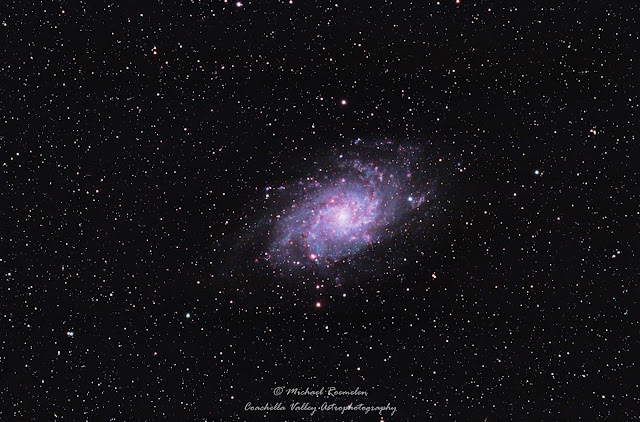
M27 The Dumbbell Nebula 5-18-16

The Dumbbell Nebula, or Messier 27 is a planetary nebula in the constellation Vulpecula. In 1764, Charles Messier discovered the Dumbbell Nebula, and was the first of its kind to be discovered, a planetary nebula. A planetary nebula is named more for its round appearance to early astronomers, and has nothing to do with actual planets. A planetary nebula is actually the remains of an old exploded star, and is made up of  ejected ionized gas.

This is a stacked image of 17 1 minute exposures at ISO 1600, 17 light frames, 17 dark frames, and 17 bias frames. Stacked in DeepSkyStacker with minor tweaks to contrast and brightness in CS6. These were all taken in my backyard in Cathedral City, CA with average seeing and visibility.

On a side note, I am personally blown away by this image. There has to be over a million stars in the picture! How cool is that right?

*UPDATE
After going through the data, and some help from internet astronomy friends, I Have re-edited using PixInsight LE and was able to pull out much more data this time around. The first 2 images are the new edits, and the last 2 images are the old data.




M27 The Dumbbell Nebula 5-18-16


Thursday, May 19, 2016

Astrophotography at The Joshua Tree National Park 5-15-16

The purpose of this blog, or website, or whatever you want to call it, is to highlight the potential of astronomy and astrophotography in the Coachella Valley and surrounding areas. Last weekend, the wife and I took a quick road trip to the Joshua Tree National Park and got some amazing astronomy and astrophotography pictures. This place is near and dear to me, and is probably my favorite of all of the national parks I have ever been to. The deserts in southern California are truly beautiful, both day and night. The potential for deep sky imaging at the Joshua Tree National Park is what draws thousands of visitors each and every year. The Milky Way is a sight to behold, and unfortunately, it is not visible in light polluted areas such as the Coachella Valley. On the plus side, we have places like the Joshua Tree National Park, Anza Borrego Desert State Park, and even beautiful skies up in the San Jacinto Mountains for night sky observations and imaging.

These images were taken with a Canon 450d, and the Milky Way shot was taken with a Celestron Nexstar 6se with the 450d attached.

Without further ado, the pictures...

night sky image joshua tree national park

camping joshua tree national park

milky way over joshua tree national park

night sky joshua tree national park

startrails joshua tree national park

startrails joshua tree national park

the arch and moon at joshua tree national park

Sunday, May 15, 2016

Mercury Transit of the Sun from the Coachella Valley 5-9-16

The Mercury transit of the Sun on May 9, 2016 did not disappoint in the Coachella Valley, California. The sky was clear, and the weather was wonderful. This was an amazing event to witness, and was my first Mercury transit ever seen. The last Mercury transit occurred in 2006 and the next one won't come until 2019. The first image is a composite showing the path of Mercury crossing the surface of the Sun. The next  picture is single frame exposure, and the last image is another single frame exposure with a bit of a zoom on Mercury. Enjoy, and happy stargazing!


Mercury Transit of the Sun from the Coachella Valley 5-9-16

Mercury Transit of the Sun from the Coachella Valley 5-9-16

Mercury Transit of the Sun from the Coachella Valley 5-9-16

Monday, May 2, 2016

Saturn over the Coachella Valley, CA 5-2-16

I got the telescope out early this morning to photograph an ISS Moon transit, but unfortunately it occurred at 6:42am and the Sun was too bright, so I was unable to catch it. I did however catch a beautiful shot of Saturn. Saturn is currently at an apparent magnitude of .17 and will peak in brightness at the beginning of June this year. This is by far my best image of Saturn to date, the surface colors look amazing, as does the famous rings. This was taken with a Celestron Nexstar 6se + Phillips spc900 webcam 24mm eyepiece 2x barlow 2000 frames stacked in Avistack.

Saturn over the Coachella Valley, CA 5-2-16

Friday, January 22, 2016

Mars - An Amateur Astronomers View 1-21-16

Not only did I take some amazing pictures of Jupiter last night (link here), I also stayed up late enough to catch a couple of the other bright planets, including our nearest neighbor Mars. This was my first attempt at really imaging Mars, and I didn't expect much out of it. Mars is currently at an apparent magnitude of 0.99, and will not peak in brightness until May 22nd at an apparent magnitude -2.06. This is when you should expect some amazing amateur astrophotography pictures of Mars!

Mars - An Amateur Astronomers View 1-21-16

Mars - An Amateur Astronomers View 1-21-16


Images taken with a Celestron Nexstar 6SE + Phillips spc900nc webcam

Friday, January 1, 2016

Jupiter, Io, Ganymede, and Europa 1-1-16

I couldn't contain myself New Years Eve and did a bit of backyard telescoping during the celebrations. With wine bottle in hand, the Wife and I set up the Telescope and listened to the symphony of celebrations being orchestrated  in and around our neighborhood. The seeing in the Coachella Valley was not in my favor, and the fireworks and waning gibbous Moon offered no real help either, but I did manage to photograph a half way decent shot of Jupiter and 3 of its moons. I hope everyone has a fantastic New Years, and cheers to 2016 in the Coachella  Valley!

Equipment used was a Celestron Nexstar 6SE, a Philips spc900nc webcam and a 2x barlow


Monday, December 14, 2015

Upcoming Star Party December 19 2015

Astronomical Society of the Desert
The Astronomical Society of the Desert is holding a Star Party this coming weekend. They welcome anyone and everyone to come out and stargaze, from amateurs to professionals. The Star Parties are open to the public, and kid friendly. This is a great way to get your kids into Astronomy and the night sky. The fun begins at 5pm - 8pm at the Visitors Center, 51-500 Highway 74, Palm Desert, CA.  Phone: 760-862-9984. Directions and information can be found here.

Guests are more than welcome to bring telescopes, binoculars, and other stargazing equipment, also note that telescopes and giant binoculars are also provided by ASOD members. Please also make sure to dress appropriately, as it has been quite chilly at night lately. The forecast as of this post does not look great, but keep an eye out over the next week. Let's hope for clear skies!

Upcoming Star Party December 19

Friday, December 11, 2015

A Picture of Saturn on 7-22-15 Webcam + Telescope

I found a picture of Saturn that I took on 7-22-15 and wanted to share it. Saturn was at apparent magnitude 0.37 and was shining brightly towards the south. This image is actually a short 2-3 minute video taken with a Logitech c310 Webcam attached to my Celestron Nexstar 6SE and I used image stacking software later on by processing the video in Avistacks, this is the end results.


A Picture of Saturn 7-22-15

Thursday, December 10, 2015

Viewing Guide to the 2015 Geminid Meteor Shower in the Coachella Valley

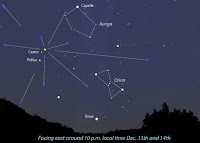
 Geminid meteor shower
Unfortunately, it looks like clouds and rain in the Coachella Valley for this years Geminid Meteor Shower. The meteor shower peaks on the night of the 13th into the pre-dawn hours of the 14th. The usual best viewing times for meteor showers is any time after midnight. As of today, the weather man is showing late night clouds and a chance of rain. We certainly need the rain out here, but I was really hoping for clear skies.

This years meteor shower is going to be a good one, with a maximum of 120 meteors per hour, weather and light pollution permitting of course. The night of the 13th and the night of the 14th will both offer great views of the meteors. If you would like more information on this years Geminid Meteor Showers you can read what NASA had to say here and here, and a great read here by Universe Today.


Monday, December 7, 2015

Introductions...

Introductions are in order, this being my first official post and all. Hello, and welcome to the Coachella Valley Astronomy and Astrophotography blog. My name is Michael Roemelen and I live in the Coachella Valley. I have been an avid amateur stargazer for years now and just recently got into taking pictures of the beautiful night skies here in the Coachella Valley and surrounding areas. I am going to take a guess here, and say that you have landed on my blog because you have an interest in Astronomy and/or Astrophotography in or around the Coachella Valley. Fantastic! Me too!

My purpose for creating this blog is to share with the world my personal pictures of the night skies. I have posted many important links that I personally use and I plan on updating the site with new and exciting pictures whenever I can. So, please feel free to stop by and utilize the links and widgets available on the site. There are links to ISS sightings, moon phases, stargazing tours, clear sky data, celestial events, and others pertaining to the Coachella Valley and Southern California.