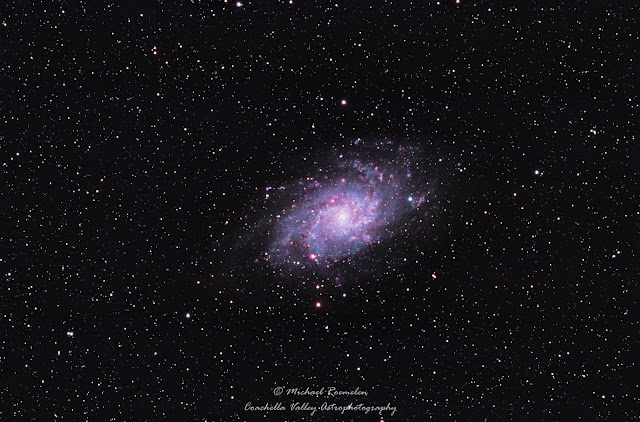
Triangulum Galaxy M33
Taken over 2 nights at Lake Cuyamaca, CA
90/500 Refractor
2" Astro-Tech Field Flattener
Canon 450d modded
Baader 495nm Longpass filter
Astronomik CLS CCD Clip Filter
Celestron AVX Mount
5 Hours total Exposure Time
20x900s ISO 800 Lights
11 Darks
43 Flats
30 Bias
Stacked in DSS, edited in CS6
The Triangulum Galaxy is a spiral galaxy approximately 3 million light-years from Earth in the constellation Triangulum. It is cataloged as Messier 33 or NGC 598, and is sometimes informally referred to as the Pinwheel Galaxy, a nickname it shares with Messier 101. The Triangulum Galaxy is the third-largest member of the Local Group of galaxies, behind the Milky Way and the Andromeda Galaxy. It is one of the most distant permanent objects that can be viewed with the naked eye.
The general purpose of this blog is to highlight the potential of astronomy and astrophotography in the Coachella Valley, CA and surrounding areas
Showing posts with label m33. Show all posts
Tuesday, September 26, 2017
Saturday, October 1, 2016
Triangulum Galaxy M33 Backyard Astrophotography
The Triangulum Galaxy, or Messier 33, is a spiral galaxy in the constellation Triangulum, and is visible to the naked eye under dark sky conditions. Unfortunately, deep sky objects like this are not visible to the unaided eye here in the Coachella Valley due to city light pollution. I was able to capture this on 9-30-16 during the new moon phase, and am very happy with how it turned out.
3 hours total exposure time
37x150s lights
12x180s lights
13x240s lights
68 darks
40 bias
38 flats
Equipment:
Celestron Nexstar 6se + wedge
6.3 focal reducer
canon 450d
asi120mc-s guiding
UPDATE!
Reprocessed this data with an additional 4 hours of exposure time for a grand total of 7 hours
3 hours total exposure time
37x150s lights
12x180s lights
13x240s lights
68 darks
40 bias
38 flats
Equipment:
Celestron Nexstar 6se + wedge
6.3 focal reducer
canon 450d
asi120mc-s guiding
UPDATE!
Reprocessed this data with an additional 4 hours of exposure time for a grand total of 7 hours
Subscribe to:
Posts (Atom)

