Showing posts with label California. Show all posts

Thursday, July 20, 2017

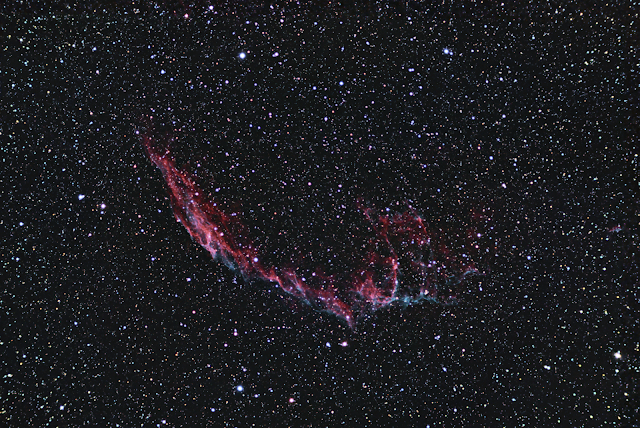
The Eastern Veil Nebula NGC 6992

The Veil nebula has been my deep sky subject for the past month, and I'm finally done with the eastern portion. The desert heat and humidity we've had recently did not help at all, but us desert rats find ways to overcome this every summer. 

Next up is the western portion of the Veil nebula, which contains NGC 6960 the Witches Broom Nebula. I'm hoping to get the western side done before the end of the month.

NGC6992 Eastern Veil Nebula
taken in Cathedral City, CA
5h40m total exposure time
61 lights 4,5, and 6 minute exposures
48 darks
64 flats
80 bias
Stacked in DSS

The Eastern Veil Nebula NGC 6992

Tuesday, April 4, 2017

Comet 41P/Tuttle-Giacobini-Kresak 4-1-17

This was my first attempt at imaging a comet, and after tons of research online I was actually able to pull off some interesting images, and even a video of its movement. Comet 41P/Tuttle-Giacobini-Kresak was not showing any signs of a tail, at least for now. The comets closest approach to the Sun is on April 12 2017, and it might start showing signs of a tail around then. Unfortunately, this comet is not really a naked eye object, and was even hard to spot in binoculars under our light polluted valley. This is why it's important to always turn off unnecessary lights at night, and if at all possible use lighting that does not pollute our night skies.

There are various ways to post process a set of comet images, one way stacks the comet and leaves the stars to trail. The other way is to stack the stars and the comet, which leaves you with a nice comet and a fairly clean star field in the background.

This was taken on 4-1-17 in Cathedral City, CA
Orion ST80
Canon 450d
Celestron AVX Mount
ASI120MC-s Guide Camera
Astromania 60mm Guidescope

Comet 41P/Tuttle-Giacobini-Kresak
 Comet with trailing stars

Comet 41P/Tuttle-Giacobini-Kresak
 Comet and corrected star field
Comet 41P/Tuttle-Giacobini-Kresak
Inverted view


Inverted timelapse video, about 2 hours
Saturday, March 11, 2017

Jupiter rotation video 3-8-17

The other night I was out in the backyard imaging Jupiter and decided to make a rotation video of the planet. I ended up with 2 separate videos because the seeing changed and I had to reduce my magnification a bit. The end results turned out pretty good though!

These were made up of individual images taken every so often between 11pm and about 3am, so around a 4 hour period of rotation.

Celestron Nexstar 6se
Celestron AVX Mount
ASI120MC-S Camera
Taken in Cathedral City, CA


Here is a couple still images from the videos:

Jupiter rotation video 3-8-17

Jupiter rotation video 3-8-17

Wednesday, October 19, 2016

Spot the Space Station over the Coachella Valley tonight


Spot the International Space Station over the Coachella Valley twice tonight! The first one is almost 7 minutes long and starts at 6:39pm. At 7 minutes long, this will appear to be a slow moving, but increasingly brightening star crossing the sky. It will appear in the Northwest at a 10 degree elevation and pass through the Little Dipper near the north star Polaris. Maximum elevation is 51 degrees, then it will start to fade away into the Southeastern sky. At a magnitude -3.6 it should be pretty bright, the Sun sets at 6:06pm so it will not be the darkest sky but I've personally seen the station pass by in daylight before, so no worries. 

The second chance tonight to spot the Space Station will be at 8:18pm, this one only last for 1 minute and will be low on the horizon at a max elevation of 11 degrees and reach a magnitude 1.0. If you have a unobstructed view of the Southwest, it will pass very near the planet Saturn. 


Saturday, October 1, 2016

Triangulum Galaxy M33 Backyard Astrophotography

The Triangulum Galaxy, or Messier 33, is a spiral galaxy in the constellation Triangulum, and is visible to the naked eye under dark sky conditions. Unfortunately, deep sky objects like this are not visible to the unaided eye here in the Coachella Valley due to city light pollution. I was able to capture this on 9-30-16 during the new moon phase, and am very happy with how it turned out.

3 hours total exposure time

37x150s lights
12x180s lights
13x240s lights
68 darks
40 bias
38 flats

Equipment:
Celestron Nexstar 6se + wedge
6.3 focal reducer
canon 450d
asi120mc-s guiding

Triangulum Galaxy M33 Backyard Astrophotography


UPDATE!

Reprocessed this data with an additional 4 hours of exposure time for a grand total of 7 hours

Triangulum Galaxy M33 Backyard Astrophotography


Wednesday, July 20, 2016

Moon Mosaic: Coachella Valley Astrophotography 7-17-16

This is not your typical Moon picture, but a mosaic of 11 pictures of the Moon stitched together to create a very large and detailed image. 

This was actually created using 11 short video clips: I pointed at one part of the Moon, took a short video at 64 frames per second, and then used stacking software which picked the best of those frames and added them together to produce a single image. I then moved the telescope to a different part of the Moon and repeated the procedure 11 times, until I had images of the entire surface of the Moon. These were then processed to sharpen the details, and finally stitched together to create the mosaic. 

Taken 7-17-16 in Cathedral City, CA
Nexstar 6se + 6.3 focal reducer
asi120mc-s camera
64fps 3000 frames per video
11 videos total
Dimensions 3300x3100


Friday, June 24, 2016

Mars 6-23-16 Cathedral City CA - Nexstar 6se asi120MC-S

Here is a shot of Mars taken last night 6-23-16. Mars is shining brightly at the moment, due to its recent opposition last month. The desert heat has limited my deep sky imaging lately due to tons of image noise, but the planets are still shining brightly, as is the moon. This was taken with my new ZWO asi120mc-s planetary camera attached to a Nexstar 6se. This camera blows my old Phillips spc900 webcam out of the water! The surface details really stick out in this one, and you can see cloud formations. This is my best image of Mars...so far!

Mars 6-23-16 Cathedral City CA - Nexstar 6se asi120MC-S


Mars 6-23-16 Cathedral City CA - Nexstar 6se asi120MC-S
Here is another one from 6-25-16, way better seeing this night!

Thursday, May 19, 2016

Astrophotography at The Joshua Tree National Park 5-15-16

The purpose of this blog, or website, or whatever you want to call it, is to highlight the potential of astronomy and astrophotography in the Coachella Valley and surrounding areas. Last weekend, the wife and I took a quick road trip to the Joshua Tree National Park and got some amazing astronomy and astrophotography pictures. This place is near and dear to me, and is probably my favorite of all of the national parks I have ever been to. The deserts in southern California are truly beautiful, both day and night. The potential for deep sky imaging at the Joshua Tree National Park is what draws thousands of visitors each and every year. The Milky Way is a sight to behold, and unfortunately, it is not visible in light polluted areas such as the Coachella Valley. On the plus side, we have places like the Joshua Tree National Park, Anza Borrego Desert State Park, and even beautiful skies up in the San Jacinto Mountains for night sky observations and imaging.

These images were taken with a Canon 450d, and the Milky Way shot was taken with a Celestron Nexstar 6se with the 450d attached.

Without further ado, the pictures...

night sky image joshua tree national park

camping joshua tree national park

milky way over joshua tree national park

night sky joshua tree national park

startrails joshua tree national park

startrails joshua tree national park

the arch and moon at joshua tree national park

Sunday, May 15, 2016

Mercury Transit of the Sun from the Coachella Valley 5-9-16

The Mercury transit of the Sun on May 9, 2016 did not disappoint in the Coachella Valley, California. The sky was clear, and the weather was wonderful. This was an amazing event to witness, and was my first Mercury transit ever seen. The last Mercury transit occurred in 2006 and the next one won't come until 2019. The first image is a composite showing the path of Mercury crossing the surface of the Sun. The next  picture is single frame exposure, and the last image is another single frame exposure with a bit of a zoom on Mercury. Enjoy, and happy stargazing!


Mercury Transit of the Sun from the Coachella Valley 5-9-16

Mercury Transit of the Sun from the Coachella Valley 5-9-16

Mercury Transit of the Sun from the Coachella Valley 5-9-16

Friday, May 6, 2016

Ring Nebula Celestron Nexstar 6SE Canon 450d

The Ring Nebula, or Messier 57, is one of my favorite planetary nebula and lies in the northern constellation of Lyra. The Ring Nebula was formed by an exploding red giant star, and is essentially a cloud of ionized gas, and to our perspective it resembles a ringed shape.

If you would like to view the Ring Nebula here in the Coachella Valley, the best time currently would be around 2am. This is a fairly faint nebula, so a high aperture telescope is needed, and I do recommend  a planetary nebula filter like a UHC. On the other hand, if you are interested in astrophotography, like myself, this was taken with a Canon 450D 30s x 30 lights 30 darks 30 bias stacked in DSS and touched up in CS6. The telescope used was a Celestron Nexstar 6SE using the standard alt-azimuth mount.


Ring nebula Celestron Nexstar 6SE Canon 450d

Ring nebula Celestron Nexstar 6SE Canon 450d


Monday, May 2, 2016

Saturn over the Coachella Valley, CA 5-2-16

I got the telescope out early this morning to photograph an ISS Moon transit, but unfortunately it occurred at 6:42am and the Sun was too bright, so I was unable to catch it. I did however catch a beautiful shot of Saturn. Saturn is currently at an apparent magnitude of .17 and will peak in brightness at the beginning of June this year. This is by far my best image of Saturn to date, the surface colors look amazing, as does the famous rings. This was taken with a Celestron Nexstar 6se + Phillips spc900 webcam 24mm eyepiece 2x barlow 2000 frames stacked in Avistack.

Saturn over the Coachella Valley, CA 5-2-16

Saturday, April 30, 2016

Milky Way, Mars, Saturn, and Antares triangle

4-30-16 High winds, poor seeing, and a last quarter Moon got in my way this morning but I did manage to catch the Mars, Saturn, and Antares triangle along with a little Milky Way so it wasn't all for nothing. This was a 2 minute exposure ISO 1600 Canon 450d piggybacked on a Celestron Nexstar 6se.

Milky Way, Mars, Saturn, and Antares triangle

Monday, April 18, 2016

The Moon 4-17-16, a Waxing Gibbous Moon 87% full

I snapped this single exposure image of the Moon tonight with my Canon 450d attached to a Celestron Nexstar 6se with a 6.3 focal reducer. Tonight's Moon is a Waxing Gibbous, and is about 87% full. This months full Moon lands on April 22nd at 1:24 am, and is called the Pink Moon in the farmers almanac due to spring flowers.

The Moon tonight 4-17-16, a Waxing Gibbous Moon 87% full

Friday, February 19, 2016

Reprocessed 2-4-16 image of Jupiter with PIPP and Autostackkert 2

Finished reprocessing my AVI from 2-4-16 of Jupiter using PIPP and Autostackkert 2. I am surprised at the extra detail I was able to pull out of the video. PIPP (Planetary Imaging Pre-Processor) does an outstanding job of pre-processing images before you start stacking them in Registax, Avistack, or whatever software you might be using for stacking planetary images. PIPP auto crops the frames and chooses only the best of the best and creates a new AVI video of the end results.

I have mixed results with Autostakkert 2, and usually prefer to use either Registax or Avistack for stacking purposes.  The old image was processed with Avistack. This time around, Autostakkert seemed to do the job much better. Afterwards, I still loaded the stacked image into Avistack and played around with the wavelets, but that was more of a personal preference.

Reprocessed 2-4-16 images of Jupiter with PIPP and Autostackkert 2
New reprocessed image of Jupiter

Reprocessed 2-4-16 images of Jupiter with PIPP and Autostackkert 2
Old processed image of Jupiter

Thursday, February 11, 2016

Jupiter in the Coachella Valley, CA night sky 2-4-16

Jupiter just keeps getting bigger and brighter as the days pass, inching its way to opposition on March 8, when it will be at its closest approach to Earth and its face will be fully illuminated by the Sun. It will be brighter than any other time of the year, peaking at an apparent magnitude of -2.49, and will be visible all night long. This is a great time to get outside and observe Jupiter and its Moons, as the weather here in the Coachella Valley has been lovely, and seeing conditions have been favorable.

These images were taken on 2-4-16 and the seeing was excellent that night. Equipment used was a Celestron Nexstar 6SE + Phillips spc900nc webcam and a 2x barlow

Jupiter in the Coachella Valley, CA night sky 2-4-16

Jupiter in the Coachella Valley, CA night sky 2-4-16

Jupiter in the Coachella Valley, CA night sky 2-4-16

Jupiter in the Coachella Valley, CA night sky 2-4-16

Jupiter in the Coachella Valley, CA night sky 2-4-16

And lastly, I would like to congratulate the @LIGO team for directly detecting Gravitational Waves today #einsteinwasright

Thursday, February 4, 2016

My second attempt at photographing the Orion Nebula M42 2-4-16

This is my second attempt at photographing the Orion Nebula. My first attempt went well, with my limited equipment and abilities. This time around, I was pleasantly surprised with what I was able to capture, and with a phone camera no less! The LG G4 is truly an amazing piece of machinery, and has a fantastic camera for astrophotography.

There is a bit of star trailing and other imperfections, but overall a huge improvement over my first try here. I used a Celestron Nexstar 6SE with a phone adapter and the G4 attached. Camera settings were 4 x 30s exposures ISO 250. The 4 images were stacked in Deep Sky Stacker, and some light editing in Photoshop to help bring out more of the gaseous details. Unfortunately, there are some star trails and doubling of stars, but this will be worked out as I get better with the editing process.

Isn't the Coachella Valley a beautiful place for Astronomy and Astrophotography? Enjoy the night skies!


Final edited image

RAW image from camera

Friday, January 22, 2016

Venus and Saturn in the pre-dawn hours 1-21-16

This is my last post of the night, and involves Saturn and Venus. Saturn is on its way up in the pre-dawn sky and Venus is on its way down. Saturn is at an apparent magnitude 0.53 and peaks on June 2nd at 0.00 apparent magnitude. The rings of Saturn are a crown jewel in our Solar System, and viewing them through a large or small telescope is really out of this world.

Venus, on the other hand has already reached its peak brightness on September 14th, at an apparent magnitude of -4.53 and currently is at a -4.00. Venus is actually taking shape and shining quite bright. The last time I did any imaging of Venus (other than the daytime Venus/Moon conjunction here) it was more of a crescent shape. Venus goes through phases similar to our Moon, because it lies in front of the earth and closer to the Sun. As it rotates around the Sun, different phases can be seen from here on Earth.


Saturn in the pre-dawn hours 1-21-16
Saturn

Saturn in the pre-dawn hours 1-21-16
Saturn

Venus in the pre-dawn hours 1-21-16
Venus


And in case you missed my previous posts today about Mars, and Jupiter here are the links

Monday, December 14, 2015

Upcoming Star Party December 19 2015

Astronomical Society of the Desert
The Astronomical Society of the Desert is holding a Star Party this coming weekend. They welcome anyone and everyone to come out and stargaze, from amateurs to professionals. The Star Parties are open to the public, and kid friendly. This is a great way to get your kids into Astronomy and the night sky. The fun begins at 5pm - 8pm at the Visitors Center, 51-500 Highway 74, Palm Desert, CA.  Phone: 760-862-9984. Directions and information can be found here.

Guests are more than welcome to bring telescopes, binoculars, and other stargazing equipment, also note that telescopes and giant binoculars are also provided by ASOD members. Please also make sure to dress appropriately, as it has been quite chilly at night lately. The forecast as of this post does not look great, but keep an eye out over the next week. Let's hope for clear skies!

Upcoming Star Party December 19