The Mercury transit of the Sun on May 9, 2016 did not disappoint in the Coachella Valley, California. The sky was clear, and the weather was wonderful. This was an amazing event to witness, and was my first Mercury transit ever seen. The last Mercury transit occurred in 2006 and the next one won't come until 2019. The first image is a composite showing the path of Mercury crossing the surface of the Sun. The next picture is single frame exposure, and the last image is another single frame exposure with a bit of a zoom on Mercury. Enjoy, and happy stargazing!
The general purpose of this blog is to highlight the potential of astronomy and astrophotography in the Coachella Valley, CA and surrounding areas
Showing posts with label Sky & Telescope. Show all posts
Sunday, May 15, 2016
Mercury Transit of the Sun from the Coachella Valley 5-9-16
Friday, May 6, 2016
Ring Nebula Celestron Nexstar 6SE Canon 450d
The Ring Nebula, or Messier 57, is one of my favorite planetary nebula and lies in the northern constellation of Lyra. The Ring Nebula was formed by an exploding red giant star, and is essentially a cloud of ionized gas, and to our perspective it resembles a ringed shape.
If you would like to view the Ring Nebula here in the Coachella Valley, the best time currently would be around 2am. This is a fairly faint nebula, so a high aperture telescope is needed, and I do recommend a planetary nebula filter like a UHC. On the other hand, if you are interested in astrophotography, like myself, this was taken with a Canon 450D 30s x 30 lights 30 darks 30 bias stacked in DSS and touched up in CS6. The telescope used was a Celestron Nexstar 6SE using the standard alt-azimuth mount.
Tuesday, April 19, 2016
Mars, Saturn, and Antares in the pre-dawn sky
Good morning Coachella Valley, I woke up early enough this morning and noticed that Mars, Saturn, and Antares were perfectly lined up in the palm trees in my backyard. So, whats an astronomer to do? Grab the camera of course! Picture taken at 5:25am, with a Canon 450d ISO 100 F/5 30s exposure
Thursday, February 4, 2016
My second attempt at photographing the Orion Nebula M42 2-4-16
This is my second attempt at photographing the Orion Nebula. My first attempt went well, with my limited equipment and abilities. This time around, I was pleasantly surprised with what I was able to capture, and with a phone camera no less! The LG G4 is truly an amazing piece of machinery, and has a fantastic camera for astrophotography.
There is a bit of star trailing and other imperfections, but overall a huge improvement over my first try here. I used a Celestron Nexstar 6SE with a phone adapter and the G4 attached. Camera settings were 4 x 30s exposures ISO 250. The 4 images were stacked in Deep Sky Stacker, and some light editing in Photoshop to help bring out more of the gaseous details. Unfortunately, there are some star trails and doubling of stars, but this will be worked out as I get better with the editing process.
Isn't the Coachella Valley a beautiful place for Astronomy and Astrophotography? Enjoy the night skies!
Final edited image
RAW image from camera
Thursday, December 10, 2015
Viewing Guide to the 2015 Geminid Meteor Shower in the Coachella Valley
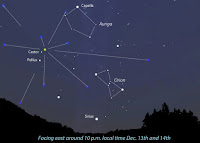
Unfortunately, it looks like clouds and rain in the Coachella Valley for this years Geminid Meteor Shower. The meteor shower peaks on the night of the 13th into the pre-dawn hours of the 14th. The usual best viewing times for meteor showers is any time after midnight. As of today, the weather man is showing late night clouds and a chance of rain. We certainly need the rain out here, but I was really hoping for clear skies.
This years meteor shower is going to be a good one, with a maximum of 120 meteors per hour, weather and light pollution permitting of course. The night of the 13th and the night of the 14th will both offer great views of the meteors. If you would like more information on this years Geminid Meteor Showers you can read what NASA had to say here and here, and a great read here by Universe Today.

This years meteor shower is going to be a good one, with a maximum of 120 meteors per hour, weather and light pollution permitting of course. The night of the 13th and the night of the 14th will both offer great views of the meteors. If you would like more information on this years Geminid Meteor Showers you can read what NASA had to say here and here, and a great read here by Universe Today.

Wednesday, December 9, 2015
Sunspots 2418 and 2415 9-18-15
Viewing Sunspots through a telescope is a wonderful way to get some use out of your telescope during the daylight hours. As always, use caution when viewing the Sun. Always use a protective Sun filter for your telescope, and never look directly at the Sun with the unaided eye.
That being said, the Sun can be as equally rewarding to stargazers and astrophotographers as the stars and galaxies of the night sky. I took this picture on September 18th, 2015 and it highlights the Sunspots 2418 and 2415. For more information on these particular Sunspots you can head on over to Spaceweather Time Machine and take a more scientific look at the data available.
Equipment used: Celestron Nexstar 6SE + Solar filter + Galaxy Note 5
Orion Constellation in Cathedral City 12-4-15
Snapped a picture of the Orion Constellation from my back yard in Cathedral City on 12-4-15 at about 2:30 am. A few stubborn wispy clouds got in the way, but the picture still turned out well. Betelgeuse is the dominate star in this picture, for good reason. Betelgeuse is about 642.5 light years away from us, and is roughly 5-30 times the mass of our Sun(seems they are still working on this number). It is classified as a red super-giant, and is defiantly one of the largest and most luminous observable stars in our night sky. This article here from EarthSky explains that someday Betelgeuse will go all supernova and that "It will run out of fuel, collapse under its own weight, and then rebound in a spectacular supernova explosion. When this happens, Betelgeuse will brighten enormously for a few weeks or months, perhaps as bright as the full moon and visible in broad daylight." Exciting times indeed!
Tuesday, December 8, 2015
Orion Nebula M42 at the Joshua Tree National Park - 11-2-15
I recently went to the Joshua Tree National Park and snapped some amazing pictures of the Orion Nebula M42. If you have never been to the Joshua Tree National Park I highly recommend it. It is a stones throw away from the Coachella Valley and it offers some of the best night sky views in the area. We usually end up at the southern entrance and camp in the Cottonwood campground, but this time we traveled much deeper into the park and stayed at the Jumbo Rock campground. The views of the Milky Way are fantastic here, and the light pollution from the surrounding areas was at a minimum. It was a much colder night than we anticipated, and the wind was a big factor, but the sky was clear so we had that going for us. The Joshua Tree National Park is home to all kinds of Astronomy related activities, such as star parties, and guided night tours of the desert. You really should check it out sometime.
Without further ado, here is the picture of the lovely Orion Nebula M42 at the Joshua Tree National Park...
Equipment used: Celestron Nexstar 6SE + Galaxy Note 5 -- 10 sec exposure 800 iso
Monday, December 7, 2015
Total Lunar Eclipse - 9/28/15
I figured since I used one of my lunar eclipse pictures as my header image, I might as well post a few more from that night. These pictures were taken during this years spectacular total lunar eclipse that occurred on September 28th. My wife and I set up the telescope in the front yard and waited for the Moon to rise. I was actually surprised and extremely excited to see a few neighbors also outside staring up in anticipation. By the time the Moon had risen above the palm trees and neighbors houses the eclipse was already underway, but I knew this was going to be the case beforehand with southern California in general. The equipment used was a Celestron Nexstar 6SE and a HTC EVO + Cell Phone Adapter Mount.
Conjunction of the Moon and Venus 12/7/2015
This morning 12/7/2015 was the 2015 Conjunction of the Moon and Venus. It occurred locally in the Coachella Valley at about 8:00 am. I was able to catch a few pictures in between wispy clouds, and it turned out to be a beautiful sight indeed.
Subscribe to:
Posts (Atom)