
Saturday, February 27, 2016
Morning Moon setting over San Jacinto Peak 2-25-16
Early morning treat 2-25-16, the Moon was setting over the San Jacinto peak so I snapped a single exposure of the event with my LG G4. The early morning Sun was starting to rise in the east, and the Moon was beginning its decent over the mountain top to the west.


Friday, February 19, 2016
Reprocessed 2-4-16 image of Jupiter with PIPP and Autostackkert 2
Finished reprocessing my AVI from 2-4-16 of Jupiter using PIPP and Autostackkert 2. I am surprised at the extra detail I was able to pull out of the video. PIPP (Planetary Imaging Pre-Processor) does an outstanding job of pre-processing images before you start stacking them in Registax, Avistack, or whatever software you might be using for stacking planetary images. PIPP auto crops the frames and chooses only the best of the best and creates a new AVI video of the end results.
I have mixed results with Autostakkert 2, and usually prefer to use either Registax or Avistack for stacking purposes. The old image was processed with Avistack. This time around, Autostakkert seemed to do the job much better. Afterwards, I still loaded the stacked image into Avistack and played around with the wavelets, but that was more of a personal preference.

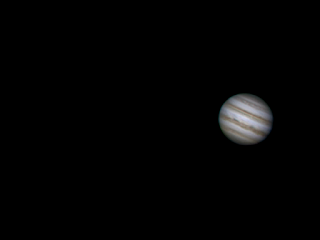
I have mixed results with Autostakkert 2, and usually prefer to use either Registax or Avistack for stacking purposes. The old image was processed with Avistack. This time around, Autostakkert seemed to do the job much better. Afterwards, I still loaded the stacked image into Avistack and played around with the wavelets, but that was more of a personal preference.

New reprocessed image of Jupiter

Old processed image of Jupiter
Thursday, February 11, 2016
Jupiter in the Coachella Valley, CA night sky 2-4-16
Jupiter just keeps getting bigger and brighter as the days pass, inching its way to opposition on March 8, when it will be at its closest approach to Earth and its face will be fully illuminated by the Sun. It will be brighter than any other time of the year, peaking at an apparent magnitude of -2.49, and will be visible all night long. This is a great time to get outside and observe Jupiter and its Moons, as the weather here in the Coachella Valley has been lovely, and seeing conditions have been favorable.
These images were taken on 2-4-16 and the seeing was excellent that night. Equipment used was a Celestron Nexstar 6SE + Phillips spc900nc webcam and a 2x barlow


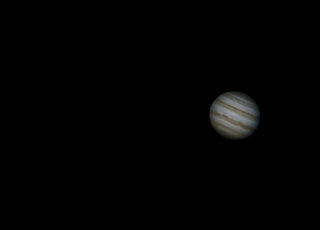


These images were taken on 2-4-16 and the seeing was excellent that night. Equipment used was a Celestron Nexstar 6SE + Phillips spc900nc webcam and a 2x barlow


And lastly, I would like to congratulate the @LIGO team for directly detecting Gravitational Waves today #einsteinwasright
Coachella Valley Crescent Moon 2-10-16
Snapped a picture of the crescent Moon last night and thought I would share it with my followers. It was a great night for stargazing here in the Coachella Valley, and the Moon did not disappoint. The crescent Moon is always my favorite phase of the Moon. I tend to picture in my head a Cheshire Cat smiling down on me from above, but unfortunately I have yet to see it manifest into an actual cat. Maybe someday right?


Thursday, February 4, 2016
My second attempt at photographing the Orion Nebula M42 2-4-16
This is my second attempt at photographing the Orion Nebula. My first attempt went well, with my limited equipment and abilities. This time around, I was pleasantly surprised with what I was able to capture, and with a phone camera no less! The LG G4 is truly an amazing piece of machinery, and has a fantastic camera for astrophotography.
There is a bit of star trailing and other imperfections, but overall a huge improvement over my first try here. I used a Celestron Nexstar 6SE with a phone adapter and the G4 attached. Camera settings were 4 x 30s exposures ISO 250. The 4 images were stacked in Deep Sky Stacker, and some light editing in Photoshop to help bring out more of the gaseous details. Unfortunately, there are some star trails and doubling of stars, but this will be worked out as I get better with the editing process.
Isn't the Coachella Valley a beautiful place for Astronomy and Astrophotography? Enjoy the night skies!


Final edited image

RAW image from camera
Friday, January 22, 2016
Venus and Saturn in the pre-dawn hours 1-21-16
This is my last post of the night, and involves Saturn and Venus. Saturn is on its way up in the pre-dawn sky and Venus is on its way down. Saturn is at an apparent magnitude 0.53 and peaks on June 2nd at 0.00 apparent magnitude. The rings of Saturn are a crown jewel in our Solar System, and viewing them through a large or small telescope is really out of this world.
Venus, on the other hand has already reached its peak brightness on September 14th, at an apparent magnitude of -4.53 and currently is at a -4.00. Venus is actually taking shape and shining quite bright. The last time I did any imaging of Venus (other than the daytime Venus/Moon conjunction here) it was more of a crescent shape. Venus goes through phases similar to our Moon, because it lies in front of the earth and closer to the Sun. As it rotates around the Sun, different phases can be seen from here on Earth.


And in case you missed my previous posts today about Mars, and Jupiter here are the links
Venus, on the other hand has already reached its peak brightness on September 14th, at an apparent magnitude of -4.53 and currently is at a -4.00. Venus is actually taking shape and shining quite bright. The last time I did any imaging of Venus (other than the daytime Venus/Moon conjunction here) it was more of a crescent shape. Venus goes through phases similar to our Moon, because it lies in front of the earth and closer to the Sun. As it rotates around the Sun, different phases can be seen from here on Earth.

Saturn

Saturn

Venus
Mars - An Amateur Astronomers View 1-21-16
Not only did I take some amazing pictures of Jupiter last night (link here), I also stayed up late enough to catch a couple of the other bright planets, including our nearest neighbor Mars. This was my first attempt at really imaging Mars, and I didn't expect much out of it. Mars is currently at an apparent magnitude of 0.99, and will not peak in brightness until May 22nd at an apparent magnitude -2.06. This is when you should expect some amazing amateur astrophotography pictures of Mars!


Images taken with a Celestron Nexstar 6SE + Phillips spc900nc webcam


Images taken with a Celestron Nexstar 6SE + Phillips spc900nc webcam
Jupiter and the Great Red Spot 1-21-16
Jupiter is putting on an amazing show during the winter months here in the Coachella Valley. The gas giant is currently at an apparent magnitude of -2.30, and gaining in brightness each day until peaking on March 6th with an apparent magnitude of -2.49 for the year. These sets of images show the great red spot and storm bands of Jupiter as it rotates across the night sky. My goal for the evening was to really capture the movements of Jupiter's surface in the span of a night. I think it went quite well, for an amateur astronomer.
The Moon is currently in a waxing gibbous phase, which means its almost a full Moon. The Moon played a small negative factor in last nights observing, but overall didn't affect the images too badly. After this months full Moon, which occurs on January 23rd, I recommend a wonderful opportunity to pull out your telescopes and cameras and view the largest planet in our solar system, as well as 4 other bright planets (Mars, Saturn, Venus, and Mercury) all in our night sky at the same time!
Stay tuned for a future post on exactly when and how to spot Mercury here in the Coachella Valley in the coming weeks. It is currently very low on the horizon at dawn and hard to catch with the mountains and palm trees in the way.
I have pieced together a GIF of this evenings Jupiter pictures showing the planetary rotation and movement of the great red spot. This was a really fun project to put together and I could not be happier with the end results.


That is not all we have for today! My next few posts will be about imaging Mars, Venus, and Saturn! I hope you enjoyed my post and I look forward to your comments and feedback via social media and the likes. Clear skies!
The Moon is currently in a waxing gibbous phase, which means its almost a full Moon. The Moon played a small negative factor in last nights observing, but overall didn't affect the images too badly. After this months full Moon, which occurs on January 23rd, I recommend a wonderful opportunity to pull out your telescopes and cameras and view the largest planet in our solar system, as well as 4 other bright planets (Mars, Saturn, Venus, and Mercury) all in our night sky at the same time!
Stay tuned for a future post on exactly when and how to spot Mercury here in the Coachella Valley in the coming weeks. It is currently very low on the horizon at dawn and hard to catch with the mountains and palm trees in the way.
I have pieced together a GIF of this evenings Jupiter pictures showing the planetary rotation and movement of the great red spot. This was a really fun project to put together and I could not be happier with the end results.

Next, we have the images that make up the GIF above. These are all stacked images with Avistack, 1800 frames to produce the final images. Taken with a Celestron Nexstar 6SE and a Phillips SPC900NC webcam.


Here are my final images of Jupiter for the night. I wanted to catch the moons Io and Ganymede, as well as a close up of the great red spot and a bit more of a magnification on Jupiter in general, enjoy!


The Great Red Spot

Jupiter and Io

Jupiter and Io

Jupiter, Io and Ganymede
Subscribe to:
Posts (Atom)